Face Recognition: How Does It Improve Security And Identity Verification?


How can security systems identify individuals without requiring passwords, access cards, or physical contact? Can artificial intelligence accurately recognize a person simply by analyzing facial features?
Face Recognition is a biometric technology that uses artificial intelligence, computer vision, and facial analysis to identify or verify individuals. It captures facial images, extracts distinctive characteristics, and compares them with stored biometric records to determine whether a match exists.
From smartphones and corporate offices to airports and financial institutions, this technology is changing how organizations manage identity verification, access control, and security monitoring.
What Is Facial Recognition Technology?
Facial recognition is a biometric identification method that analyzes an individual's facial characteristics to establish or verify identity.
Unlike conventional authentication methods that depend on passwords, PINs, or identification cards, facial recognition uses measurable facial features to perform identity comparisons.
Modern systems rely on machine learning and computer vision to process facial images and generate mathematical representations that can be compared with enrolled biometric records.
The technology primarily supports identity verification, which checks whether someone matches a claimed identity, and identification, which searches for a potential match within a database.
How Does Facial Recognition Technology Work?
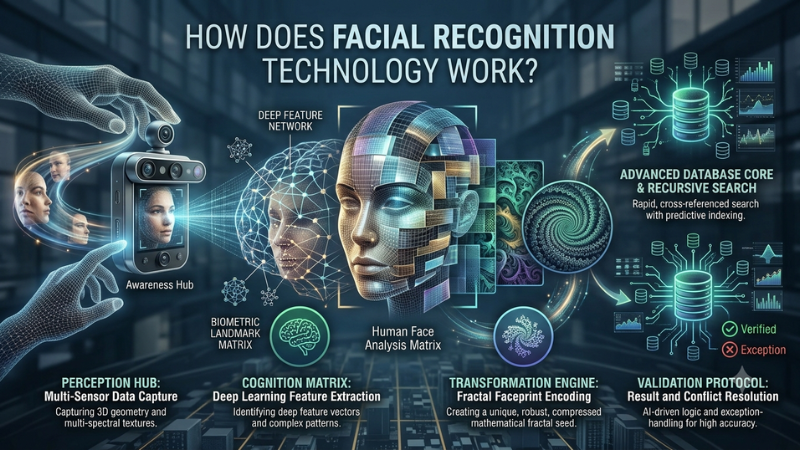
Facial recognition systems follow a structured process involving image capture, feature extraction, biometric comparison, and identity verification.
Facial Detection and Image Capture
The process begins when a camera captures an image or video containing a person's face. Computer vision algorithms locate the facial region and separate it from the surrounding environment.
Camera resolution, lighting conditions, facial positioning, and image clarity influence the quality of captured information.
Facial Feature Extraction
After detecting the face, artificial intelligence algorithms analyze facial characteristics and convert the information into numerical features.
These features represent patterns associated with facial structure and help distinguish one enrolled individual from another.
Biometric Template Generation
The extracted information is converted into a mathematical representation called a biometric template.
This template allows the system to compare facial characteristics efficiently without requiring a direct comparison of every image pixel.
Facial Matching and Verification
Video Analytics processes captured video footage using artificial intelligence and advanced algorithms to identify objects, detect movement, and analyze activities. The system evaluates visual patterns in real time to recognize unusual behavior, identify potential security threats, and generate automated alerts for faster response and improved surveillance efficiency
Authentication and Access Decision
When verification meets the configured security requirements, the connected system may approve authentication or permit access.
For example, an electronic access-control system may unlock a restricted door after successful verification.
Where Is Facial Recognition Technology Commonly Used?
Commercial Buildings and Corporate Offices
Businesses can use facial authentication to manage employee access and protect restricted areas such as server rooms, laboratories, and administrative offices.
Integration with electronic doors and security management platforms can simplify identity verification.
Airports and Transportation Facilities
Airports may use facial recognition to support passenger verification, boarding procedures, and selected security checkpoints.
Its implementation depends on regulatory requirements, operational policies, and appropriate identity-management safeguards.
Banking and Financial Institutions
Financial institutions can use facial verification during digital account registration, customer authentication, and selected financial transactions.
Additional authentication measures help protect against impersonation and fraudulent activity.
Smartphones and Personal Devices
Many smartphones use facial authentication to unlock devices, authorize selected transactions, and protect personal information.
Security effectiveness depends on the device's sensors, recognition technology, and anti-spoofing capabilities.
Residential Communities and Gated Properties
Residential buildings can use facial authentication to verify registered residents and manage access to common facilities.
When integrated with visitor management systems, it can support controlled entry while reducing dependence on physical credentials.
How Can Organizations Implement Facial Recognition Effectively?
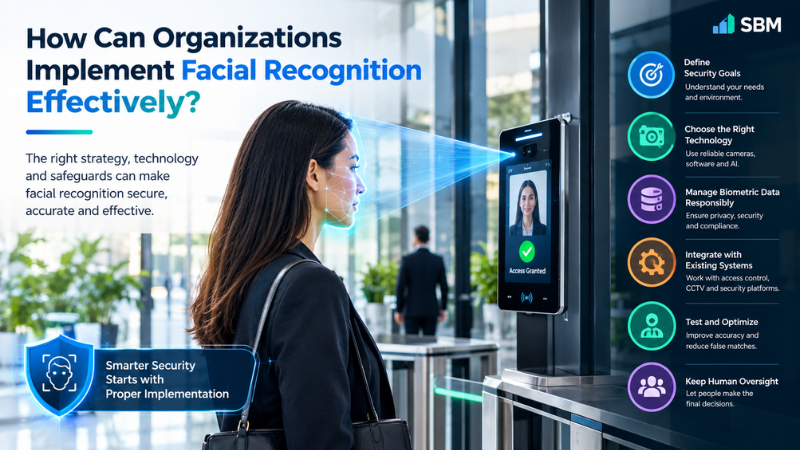
Successful implementation requires evaluating security objectives, facility requirements, camera infrastructure, and user authentication needs.
Organizations should select appropriate recognition software, establish reliable enrollment procedures, and integrate the technology with existing security platforms.
Face Recognition should be supported by secure biometric data management, regular accuracy testing, appropriate privacy safeguards, and alternative authentication methods.
For sensitive applications, automated recognition results should support human decision-making rather than independently determine consequential outcomes.
What Is the Future of Facial Recognition Technology?

Advancements in artificial intelligence, computer vision, and biometric authentication are expected to improve recognition capabilities and system integration.
Future developments may focus on stronger presentation-attack detection, improved recognition under challenging conditions, and privacy-conscious identity verification.
As adoption expands, organizations will need to balance operational convenience with accuracy, transparency, security, and individual privacy.
You can also watch: AI-Powered Line Cross Detection: Secure Your Restricted Zones
Conclusion
Facial recognition technology is transforming modern security by enabling automated identity verification, contactless authentication, and intelligent access management.
Its applications extend across commercial buildings, residential communities, transportation facilities, financial institutions, and consumer devices.
For organizations seeking faster vehicle verification, improved access control, and smarter security operations, Boom Gates Are Losing to ANPR as automated number plate recognition technology delivers a more efficient, intelligent, and scalable solution for modern vehicle access management, reducing manual intervention while improving traffic flow and security monitoring.
Frequently Asked Questions
Is Facial Recognition Technology Accurate?
Modern facial recognition systems can achieve high accuracy under suitable conditions. However, performance depends on image quality, system configuration, environmental conditions, and matching thresholds.
Can Facial Recognition Work in Low-Light Conditions?
Yes. Systems equipped with appropriate infrared sensors or specialized illumination can operate in low-light environments.
Is Facial Recognition More Secure Than Passwords?
Facial authentication can improve convenience and reduce certain credential-related risks. However, overall security depends on system design, anti-spoofing protection, and additional authentication safeguards.
Can Facial Recognition Be Integrated With CCTV Systems?
Yes. Compatible CCTV cameras can support facial recognition when connected to suitable software, processing infrastructure, and security management platforms.
Comments