AI Video Analytics: Can Smart Cameras Detect Threats Before Humans Do?


What if a security camera could do more than record an incident after it happened? Could it recognize suspicious movement, identify unusual activity, and alert security teams in real time? AI Video Analytics brings intelligence to video surveillance by combining artificial intelligence, computer vision, and automated event detection.
Traditional CCTV systems mainly capture and store footage, leaving people responsible for watching screens and finding important moments later. Intelligent video systems take a different approach by analyzing what cameras see and highlighting events that may require attention. This can make security operations faster, more focused, and easier to manage.
How Does Intelligent Video Monitoring Actually Work?
The technology starts with cameras capturing live footage from an environment. Depending on the system, video processing may take place directly on the camera, through an edge device, or on a centralized server.
Computer vision algorithms examine the footage and identify objects such as people, vehicles, or other predefined subjects. The system can then follow their movement across multiple frames to understand what is happening within the scene.
Rules can be configured to define specific events. For example, a security team may create a virtual boundary around a restricted area. If a person crosses that boundary, the system can recognize the event and generate an alert.
This process allows surveillance systems to move from simply recording activity toward continuously interpreting it.
Can Cameras Recognize Suspicious Activity?
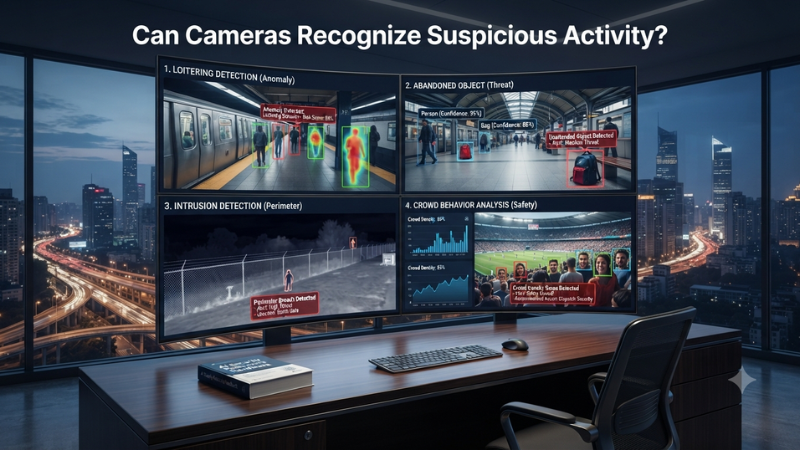
Yes, depending on the capabilities of the system, AI Video Analytics can be configured to identify different types of activity, including unauthorized entry, unusual movement, loitering, abandoned objects, crowd formation, and vehicles entering restricted areas.
The technology does not necessarily determine whether an event is criminal or dangerous on its own. Instead, it identifies activity that matches predefined patterns or rules and brings it to the attention of security personnel.
This distinction is important because human operators can review the alert, understand the context, and decide what action should be taken.
Where Can Intelligent Video Monitoring Make a Difference?
Retail Stores
Retailers can use intelligent cameras to monitor entrances, exits, restricted areas, and customer movement. The technology can also provide information about occupancy and traffic patterns, helping businesses understand how spaces are being used.
Warehouses and Factories
Industrial environments can use automated video analysis to monitor restricted zones, detect unauthorized access, and identify specific safety-related events. This can help security and operations teams maintain better awareness around critical areas.
Roads and Transportation
Traffic environments can benefit from automated vehicle detection, congestion monitoring, wrong-way detection, and incident identification. Instead of relying entirely on manual observation, operators can receive alerts when predefined traffic conditions occur.
Offices and Commercial Buildings
Businesses can use intelligent surveillance to monitor entrances, sensitive areas, parking facilities, and movement around important assets. Alerts can help security teams investigate unusual activity without constantly watching every camera feed.
What Can Affect Detection Accuracy?

Intelligent video systems are not equally effective in every environment. Several factors can influence how accurately events are detected.
Lighting is particularly important because poor visibility can make object recognition more difficult. Camera placement also matters because blocked views, unsuitable angles, and excessive distance can reduce detection quality.
Weather, crowds, reflections, shadows, and low-resolution footage can create additional challenges. Organizations should therefore test systems under real operating conditions rather than assuming that performance will remain the same in every environment.
Configuration is equally important. Detection zones, sensitivity settings, and event rules should be adjusted according to the specific location and security requirements.
Does Smart Surveillance Eliminate Human Monitoring?
No. Instead, a CCTV camera system can make human monitoring more efficient. Automated systems are useful for identifying potential events, but people remain important for verifying alerts and understanding context.
For instance, if a person enters a restricted area, the system can highlight the event and provide the related footage. A security operator can then determine whether the person is authorized, whether the activity is harmless, or whether further action is necessary.
This combination of automated detection and human judgment can provide a practical balance between technology and traditional security operations.
What Could the Future of Video Surveillance Look Like?

The next generation of surveillance technology is likely to become increasingly capable of understanding activity rather than simply detecting individual objects. Improvements in computer vision may allow systems to recognize more complex patterns and provide more context around events.
Edge processing may also become more common because analyzing footage closer to the camera can reduce latency and limit the amount of video that needs to be transmitted elsewhere.
At the same time, privacy, transparency, accuracy, and responsible use will remain important considerations as intelligent surveillance becomes more widespread.
You can also watch: AI-Powered Line Cross Detection: Secure Your Restricted Zones
Summary
AI Video Analytics makes surveillance more proactive by allowing cameras and software to detect objects, movements, and predefined events automatically. It can help security teams identify incidents faster, reduce manual footage review, and improve monitoring efficiency.
However, effective AI Video Analytics deployment requires suitable cameras, accurate configuration, reliable infrastructure, privacy safeguards, and human oversight.
Frequently Asked Questions
What does AI video analytics do?
It analyzes live or recorded video to identify objects, movements, behaviors, and predefined events, then provides alerts or searchable information when relevant activity occurs.
Is AI video analytics useful for CCTV?
Yes. It can add intelligent detection capabilities to surveillance environments, helping organizations move beyond basic video recording and monitoring.
Can it detect people and vehicles?
Many systems can detect and track people and vehicles, although the exact capabilities depend on the analytics software, camera quality, and deployment environment.
Does it work in real time?
Many solutions support real-time analysis and can generate alerts when predefined events are detected, although processing speed depends on the system architecture and available hardware.
Is human supervision still necessary?
Yes. Human operators can verify alerts, interpret context, and make decisions that automated detection alone may not be able to make reliably.


Comments